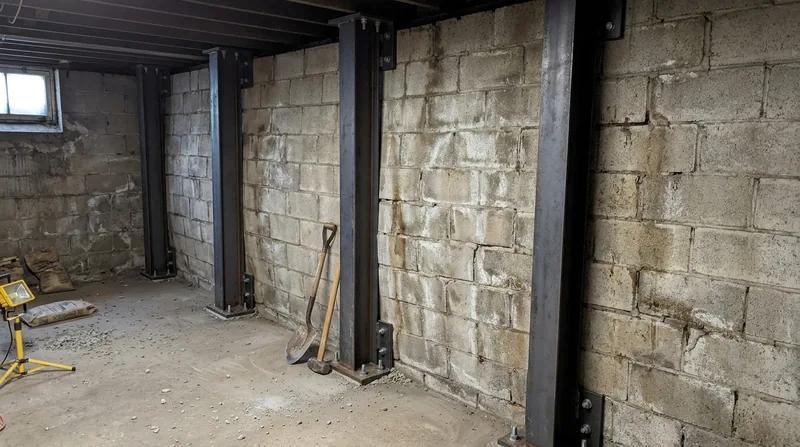




Fargo sits on the flat bed of glacial Lake Agassiz, and that means one thing for basements: heavy gray Red River clay that swells when wet and shrinks when dry. In the older neighborhoods like Downtown, Hawthorne, Roosevelt and Oak Grove, 1900s to 1940s brick and frame bungalows and foursquares have full basements built with poured concrete, block or early stone walls. Those walls have been fighting hydrostatic pressure for a century. When the spring snowmelt hits and the Red River flood stage pushes the water table up, Bowing Wall Repair in Fargo becomes the difference between a wall that leans and a wall that fails. We read the movement, match the fix to your soil, and stop the bow before it becomes a collapse. If your wall is already showing a horizontal crack or a lean, start with a free basement inspection so we can measure the problem before it gets worse.
Why Bowing Walls Are a Fargo Problem, Not a Cosmetic One
Fargo's glacial clay soil holds water and drains slowly, so the water table stays high through spring. That constant pressure against a block or stone wall causes it to bow inward over time. The freeze-thaw cycle makes it worse: water gets into hairline cracks, freezes, expands, and pushes the wall further out of plumb. Older homes in Hawthorne and Roosevelt are the most common candidates, but 1950s to 1970s ranches on the east and south sides also show movement when their original drain tile is clogged. Here is what we look for during an inspection:
- Horizontal cracking near the middle of the wall, which usually signals active pressure.
- A visible lean or bow you can spot by eye or with a straightedge held against the wall.
- Efflorescence (white powder) that shows water is moving through the concrete or block.
- Doors and windows that stick or bind because the wall has moved the frame.
- Previous patching or parging that has cracked again in the same area.
Any one of these signs means the wall needs to be evaluated before the next spring melt.
Key info: A 1920s block foundation in the Oak Grove area may bow because the original weeping tile is crushed and the clay is saturated. A 1990s poured wall in south Fargo may bow because the backfill was never properly compacted. Same symptom, different cause, and the repair has to match the cause.
For official guidance on structural repair permits and contractor licensing in North Dakota, check the North Dakota State Board of Architecture and Landscape Architecture and your local building department before any structural work begins.
How We Repair a Bowing Wall in Fargo: Measure, Stabilize, Verify
We do not guess at wall movement. The first step is a site visit where we measure the bow with a plumb line or laser, map the cracks, and check the soil and drainage conditions around the foundation. Then we match the repair method to the severity. A wall that has moved less than an inch may only need carbon fiber straps. A wall that has moved more than two inches or is actively moving may need steel I-beams or wall anchors. Here is our process:
- We inspect the full wall and document the bow, crack pattern, and moisture readings.
- We check the exterior grade, downspout extensions, and drain tile condition to find the water source.
- We recommend the least invasive method that will stabilize the wall, not the most expensive one.
- We install carbon fiber straps, steel I-beams, or anchors based on the movement and soil pressure.
- We verify the repair and give you a transferable warranty on the stabilization work.
The goal is to stop the movement and keep the wall where it is, not to push it back into place, which can crack the wall further.
Key info: In a 1950s ranch near Horace, we found a block wall bowed about 1.5 inches with a horizontal crack at mid-height. The cause was a failed footing drain and saturated clay. We installed carbon fiber straps and repaired the drain tile, and the wall has held steady through two spring melts.
If the bow is caused by water pressure, the wall repair alone is not enough. Pair it with foundation waterproofing to relieve the hydrostatic pressure that caused the movement in the first place.
Bowing Wall Repair Methods We Use in Fargo
Not every bowing wall needs the same fix. The right method depends on how far the wall has moved, whether it is still moving, and what the soil is doing. We use four main approaches, and we explain the trade-offs before you commit.
| Approach | Description | Best for |
|---|---|---|
| Carbon fiber straps | Epoxy-bonded straps run vertically from floor to sill, adding tensile strength to the wall. | Bows under 2 inches with no active movement. |
| Steel I-beams | Galvanized beams anchored to the floor and sill, braced against the wall face. | Larger bows or block walls with multiple cracks. |
| Wall anchors | Anchors set in the exterior soil, connected through the wall to an interior plate. | Active movement where the wall needs to be pulled back. |
| Epoxy injection | Structural epoxy injected into cracks to restore wall integrity and stop water. | Hairline to quarter-inch cracks in poured walls. |
We match the method to the wall, not to a sales target, and we tell you when a simpler fix will hold.
Bowing Wall Repair Cost in Fargo: What to Expect
Bowing wall repair pricing in Fargo starts at $600 for minor crack injection and evaluation, and moves up from there. The biggest cost drivers are the repair method, the length of the wall that has moved, and whether the drainage system needs repair at the same time. A carbon fiber strap job on a 20-foot wall is a different scope than steel I-beams on a full basement wall with active movement. Access matters too: a finished basement with drywall and framing means more prep work than an unfinished one.
We give you a written estimate with the method, materials, and warranty spelled out. Getting two or three estimates is smart because you can compare the diagnosis, not just the price. A contractor who quotes a number without measuring the bow is guessing. For a full breakdown of what we charge, see our pricing page.
What to Look for When Hiring a Bowing Wall Repair Contractor Near Me in Fargo
Hiring the right contractor for a bowing wall is not about the lowest bid. It is about a contractor who measures the movement, explains the cause, and stands behind the work. Here is what to check before you sign:
- Confirm the contractor is licensed and insured in North Dakota, and ask for a certificate of insurance.
- Get at least two or three written estimates that describe the method and materials, not just a price.
- Ask for references from jobs in Fargo or West Fargo done in the last two years.
- Ask who pulls the permit. Structural foundation repair usually requires a permit, and the rules vary by jurisdiction, so check with the local building department.
- Ask about the warranty: it should be transferable and in writing, not a verbal promise.
A contractor who cannot answer these questions is not the one you want holding your wall.
Ready to get a straight answer on your wall? Contact us for a free estimate at (701) 639-2877. Licensed and insured.
Bowing Wall Repair in Fargo: Pricing Guide
| Service | Price | Details |
|---|---|---|
| Crack injection and evaluation | Starting at $600 | Includes inspection, measurement, and epoxy injection for minor cracks; price rises with crack length and wall access. |
| Carbon fiber straps | Starting at $1,200 | Includes straps, epoxy, and installation for a typical wall; cost moves with wall length and number of straps needed. |
| Steel I-beams | Starting at $2,500 | Includes beams, anchoring, and bracing; price depends on wall height, beam count, and basement finish level. |
| Wall anchors | On estimate | Requires exterior excavation and soil assessment, so we need an on-site look before quoting. |
| Travel | Included | In Fargo and surrounding areas, no separate call-out or mileage fee. |
| Estimate | Free | Response within 24h at (701) 639-2877, no obligation to book. |
Indicative pricing, the exact cost depends on square footage, finish, and site access. Free personalized estimate within 24h at (701) 639-2877.


